

For decades, the EB-5 Immigrant Investor Program has been the gold standard for investment-based U.S. residency. However, President Trump’s proposed $5 million Gold Card visa has introduced uncertainty for prospective investors, raising questions about the future of EB-5 and whether investors should act now.
Despite the political discussions surrounding immigration reform, EB-5 remains the most cost-effective and secure route to obtaining a U.S. Green Card—but the window of opportunity is closing.
Understanding the EB-5 Grandfathering Rule: How Much Time Do Investors Have?
-
The EB-5 program remains authorized until September 30, 2027, but investors have only until September 30, 2026, to apply under current regulations and secure protection from future changes.
-
If the Gold Card visa gains traction, EB-5 could see major modifications, including higher investment requirements, stricter regulations, or even complete replacement.
-
The grandfathering rule ensures that any investor who files an EB-5 petition before September 30, 2026, will be processed under the current $800,000 investment requirement—even if future laws change.
What Are the Key Differences Between the EB-5 Visa and the Proposed Gold Card Visa?
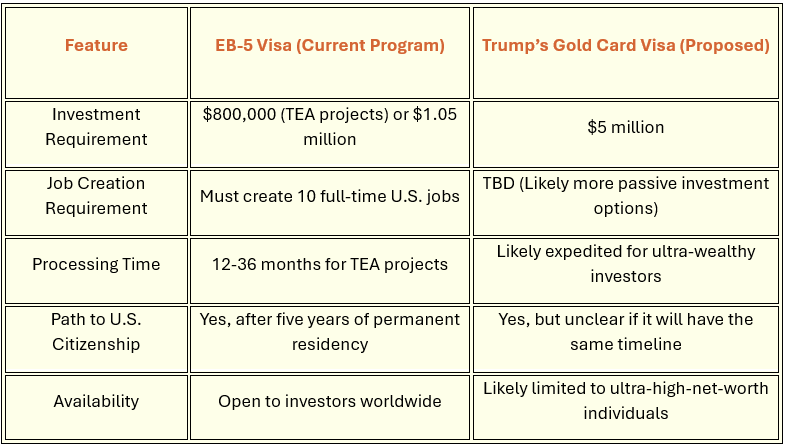
Can the Gold Card Visa Replace EB-5? What Investors Need to Know
-
EB-5 Cannot Be Unilaterally Eliminated by the President – Because EB-5 is a congressionally approved program, it cannot be removed by executive order.
-
Legislative Approval is Required – Any change to EB-5 or introduction of the Gold Card visa must pass through Congress, a process that could take months or years.
-
The Grandfathering Rule Protects EB-5 Investors – If the Gold Card visa is enacted, only those with pending EB-5 applications before September 30, 2026, will be guaranteed processing under existing rules.
Investor Insight: If the Gold Card visa moves forward, investors who wait may find themselves forced to commit $5 million instead of the current $800,000 investment under EB-5. Acting now ensures cost certainty and regulatory protection.
Why EB-5 Remains the Best Path to U.S. Residency – But Time is Running Out
Despite political discussions, EB-5 is still the most affordable and strategic U.S. investment immigration option. Here’s why:
-
Lower Investment Requirement Compared to Gold Card Visa – $800,000 is significantly more accessible than $5 million.
-
Established Processing Framework – EB-5 has structured approval timelines and a clear pathway to citizenship.
-
Family Inclusion – The EB-5 visa covers the investor, their spouse, and children under 21, ensuring U.S. residency for the entire family.
-
Priority Processing for TEA Projects – Investors who select rural EB-5 investments receive faster processing under current rules.
An investor from Brazil applying for EB-5 today secures U.S. Green Card eligibility at the lowest investment threshold—while those who delay may be forced into the $5 million Gold Card visa.
Should Investors Still Choose EB-5?
Given the uncertainty surrounding the Gold Card visa and potential EB-5 restrictions, waiting is no longer an option. Investors should:
-
Apply before September 30, 2026, to lock in EB-5 eligibility at $800,000
-
Secure residency for their entire family under existing rules
-
Avoid potential price hikes and policy changes that could limit visa availability
At Strategic Minds Global Consulting (SMGC), we help investors navigate the evolving landscape of U.S. investment immigration, ensuring they make timely and informed decisions.
The countdown to EB-5’s grandfathering deadline is on. Act now before it’s too late!